
A massive pan-India inoculation drive against COVID-19 was set in process on Tuesday with more than 56 lakh doses of the Covishield vaccine flown to 13 cities across India from Pune and taken to designated national and state-level stores amid tight security.

The first dry run of the vaccination drive took place across 125 districts covering all States/UTs on January 2. The dry run was also conducted to familiarise the state, district, block, and hospital-level officers on all aspects of the COVID-19 rollout.

India has purchased 500 million doses of the Oxford University-AstraZeneca vaccine candidate, one billion from the United States company Novavax and 100 million doses of the Sputnik V candidate from Russia's Gamaleya Research Institute, according to the US-based Duke University Global Health Innovation Center.
'In the case of Aadhaar, we were able to build and enrol 1 billion in five-and-a-half years.' 'For vaccination, it can be done even faster -- in just two years.' 'When everybody is coming for vaccination, they can be offered a choice -- to create a health record and a digital ID.'

It is our only chance of avoiding a repeat of our catastrophic second wave, asserts Naushad Forbes.
'In 2009 we had 741 new cases of polio. This was the highest in the world. We ran the most apolitical crusade ever. We had the support of every government. We were never short of funds. The central government gave us Rs 11,000 crore a year. In 2011 we had 42 new cases. From 42 to 0 was our most difficult phase,' Mission Director Anuradha Gupta tells Rediff.com's A Ganesh Nadar in an exclusive interview about India's monumental campaign to eradicate polio.

Technology can certainly gain India membership in the comity of modern nations in the 21st century.

The first COVID-19 vaccine shots in India were given on Saturday to nearly two lakh frontline healthcare and sanitary workers as Prime Minister Narendra Modi rolled out the world's largest inoculation drive against the pandemic that has caused 1,52,093 deaths and upended millions of lives in the country.

'Ignorance isn't a problem when it's a question of common citizens having forgotten (or never learnt) middle school science.' 'It becomes a problem when it's displayed by policymakers and people of some influence,' says Devangshu Datta.

'The government is abdicating its responsibility on healthcare.' 'Just to start this scheme, it will take a minimum till October 2018 and elections are coming in 2019, so before that this can go into the dustbin.'

Around 60,000 people are expected to attend the free Global Poverty Project Global Citizens festival in Central Park on September 26. One of them will be Prime Minister Narendra Modi.

'By the time actual action began, it was already too late.' 'The virus was raging.'

'We must not compromise with the standard, the quality. We don't need to be the first to launch a drug but what we need is a Made in India vaccine that the entire world can rely on'
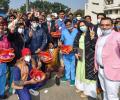
Loud applause and cheers rang out as the first jabs were administered to frontline workers at hospitals and healthcare centres across the country on Saturday at the start of the gargantuan COVID-19 vaccination exercise, hailed as a 'momentous' occasion in India's fight against the pandemic.

The 'terrible' surge of the coronavirus cases in India has severely impacted COVAX's vaccine supply in the second quarter of this year to the extent that there will be a shortfall of 190 million doses by the end of June, according to a joint statement by the WHO, UNICEF, GAVI and CEPI.

Top Union ministers on Saturday joined a gala event, which had a smattering of Bollywood actors, including megastar Amitabh Bachchan, aimed at publicising the "achievements" of the Narendra Modi government on completion of two years in office.

That's what teachers are telling students in many Indian schools.

'Prevention plus vaccination is what is going to take us into better territory by September or October.'

Each 'adarsh village' should have piped drinking water, connectivity to the main road, electricity supply to all households, library, telecom and broadband connectivity including CCTVs in public areas. Emphasis will also be on e-governance, says Sheela Bhatt/Rediff.com.
